
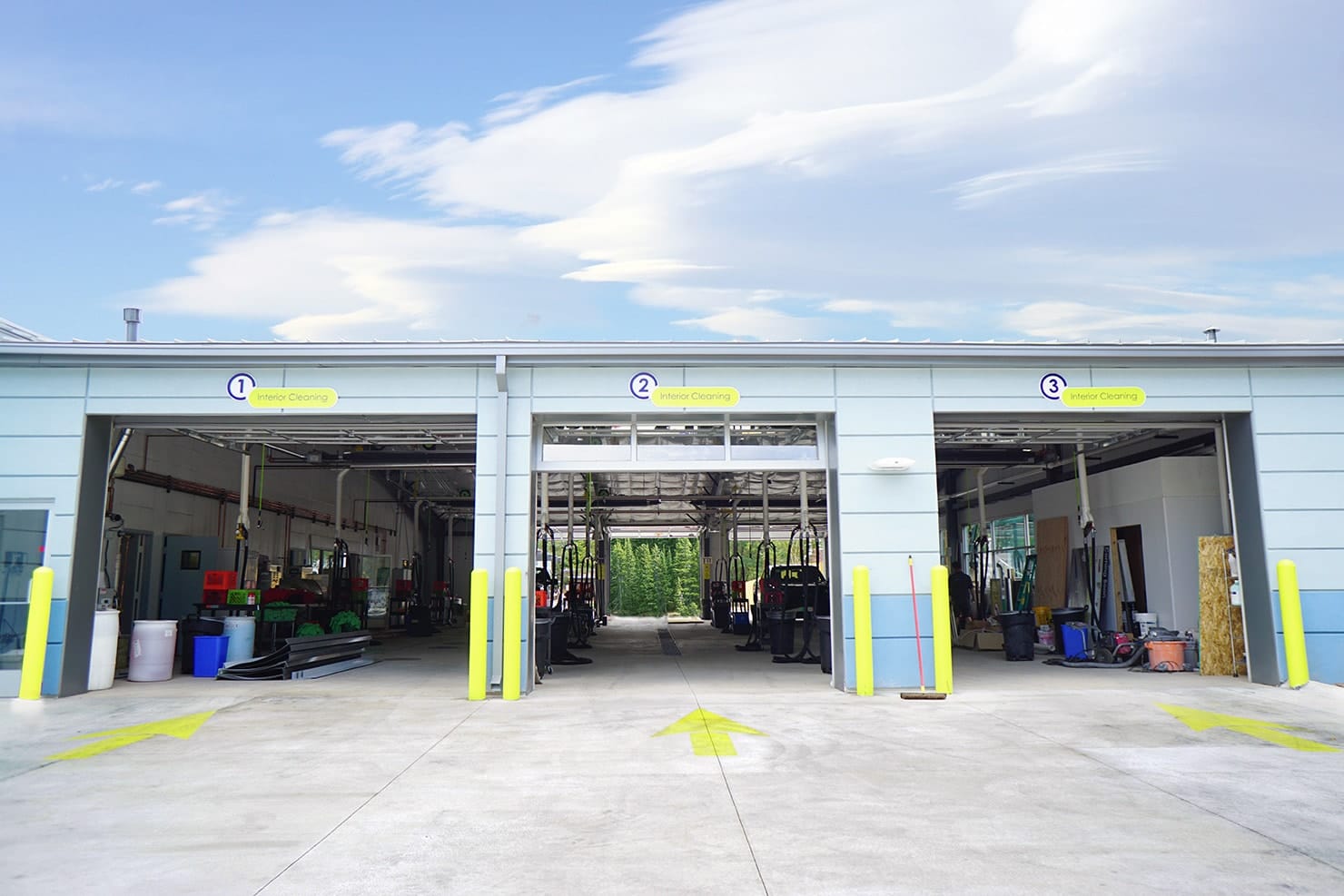
A roof that fights moisture from both sides
A car wash is one of the few buildings where the roof deck is under attack from below as much as from above. Inside an express tunnel the air sits near saturation for most of the operating day, and that warm vapor carries detergent, wax, tire-shine, and rust-inhibitor chemistry straight up into the underside of the deck and the bottom of the fasteners. On the Gulf Coast, where the outdoor humidity is already high for much of the year, that interior moisture has very little chance to dry out. We approach Mobile car wash roofs as a vapor-control problem first and a weather problem second, because the slow corrosion you cannot see from the parking lot is what shortens these roofs.
Car washes here cluster along the high-traffic retail spines where the cars are. The Airport Boulevard corridor, the Schillinger Road and Cottage Hill stretch out west, the Government Boulevard and Government Street commercial run, and the booming Eastern Shore retail along US-98 in Daphne and Spanish Fort all carry tunnels, in-bay automatics, and self-serve operations. Many of them sit on outparcels in front of larger shopping centers, which means the roof is small, highly visible from the road, and surrounded by neighboring tenants who notice scaffolding and noise. We plan around that exposure.
Why standard membranes fail over a wash tunnel
The single biggest mistake on a car wash reroof is treating the tunnel like an ordinary low-slope roof. The alkaline detergents and the petroleum-based wax and tire-dressing compounds that go airborne during the wash cycle are aggressive toward the chemistry of most single-ply membranes. TPO and EPDM both lose ground over time to that exposure. Over the active wash bays we specify PVC, typically a 60-mil fleece-back or fully adhered sheet, because its plasticizer chemistry holds up far better against the wax and detergent stream. A fully adhered sheet also stops the membrane flutter that the tunnel's fans and door cycling create on a mechanically attached system.
The penetrations are the other failure point. A wash tunnel runs high-volume exhaust to pull steam out of the building, and those fans never stop during business hours. Standard curb flashing is not built for continuous warm, chemical-laden airflow. We treat every exhaust fan, every steam stack, and every conduit run as its own detail and size the curb and flashing for the load it actually carries, not for a generic equipment template.
The vacuum canopies and customer canopies
Most Mobile express washes have a field of vacuum stalls under a canopy on the exit side, plus an entry canopy over the pay lanes. These are usually metal or membrane-clad and they take a beating from vehicle exhaust, overspray, and the relentless thermal cycling of a Gulf summer. The transition where the canopy meets the main building, and the points where the canopy posts or drains tie into the roof, are where we find the most chronic leaks on these properties. We re-flash those junctions and check the canopy gutters and downspouts as part of the same scope so the whole site is addressed at once, not just the main roof.
Drainage on flat bay roofs
In-bay automatics and self-serve operations carry less chemical vapor than a full tunnel, but they bring their own problem: the roofs above the equipment bays are often dead-flat and prone to ponding. Standing water in our climate accelerates membrane aging and adds load the original deck was not designed to hold long-term. Where we find ponding we design tapered insulation to move water to the drains or scuppers rather than leaving it to evaporate, which on a humid coast it largely will not do.
Working around a wash that never closes
Most washes in this market run seven days a week through the warm season, and a closed day is lost revenue. We sequence tunnel work into the early-morning or late-evening shoulder hours when the bays are down, and keep the exterior building and canopy work moving during business hours with traffic control that keeps cars clear of the crew. Each section is dried in watertight before the next wash cycle starts.
What you get from us
- A membrane chosen for the actual chemical program running in your tunnel, with manufacturer compatibility confirmed before we order material.
- Oversized, individually detailed curbs and flashings at every exhaust fan and steam stack.
- Vacuum and entry canopy roofs, gutters, and canopy-to-building transitions addressed in the same scope.
- Tapered insulation to eliminate ponding over bay roofs that drain poorly.
- Sequencing matched to your operating hours so the wash keeps running.
Car Wash Roofing Questions
Why PVC instead of TPO over the wash bays?
The detergents, waxes, and tire-dressing compounds that go airborne in a tunnel are hard on membrane chemistry. PVC resists that exposure better than TPO or EPDM over the long run, so we specify a 60-mil PVC sheet, fleece-back or fully adhered, over the active bays. Outside the tunnel, equipment rooms, lobby, canopies, a standard membrane is fine.
Does car wash chemistry void a membrane warranty?
Many standard single-ply warranties exclude chemical exposure. Before we order, we confirm with the manufacturer that your specific wash chemistry is compatible with the membrane and that the warranty covers it. Some makers offer chemical-exposure or car-wash-specific warranties, and we identify those during the specification stage.
How do you keep the deck from corroding from the inside?
The constant interior humidity in a tunnel drives moisture up into the deck and fasteners. We treat the assembly as a vapor-control problem, looking at the deck condition, the need for a vapor retarder, and exhaust performance, so the corrosion you can't see from outside doesn't quietly shorten the roof.
Can you do the work without closing the wash?
Yes. We schedule tunnel roof work into the early-morning or late-evening hours when the bays are down and keep canopy and exterior work moving during the day with traffic control. Every section is dried in watertight before the next wash cycle.
Do you handle the vacuum and entry canopies too?
Yes. The canopy roofs, their gutters and downspouts, and the transitions where they meet the main building are part of our scope. Those junctions are the most common chronic leak point on express washes, so we address them at the same time as the main roof.