
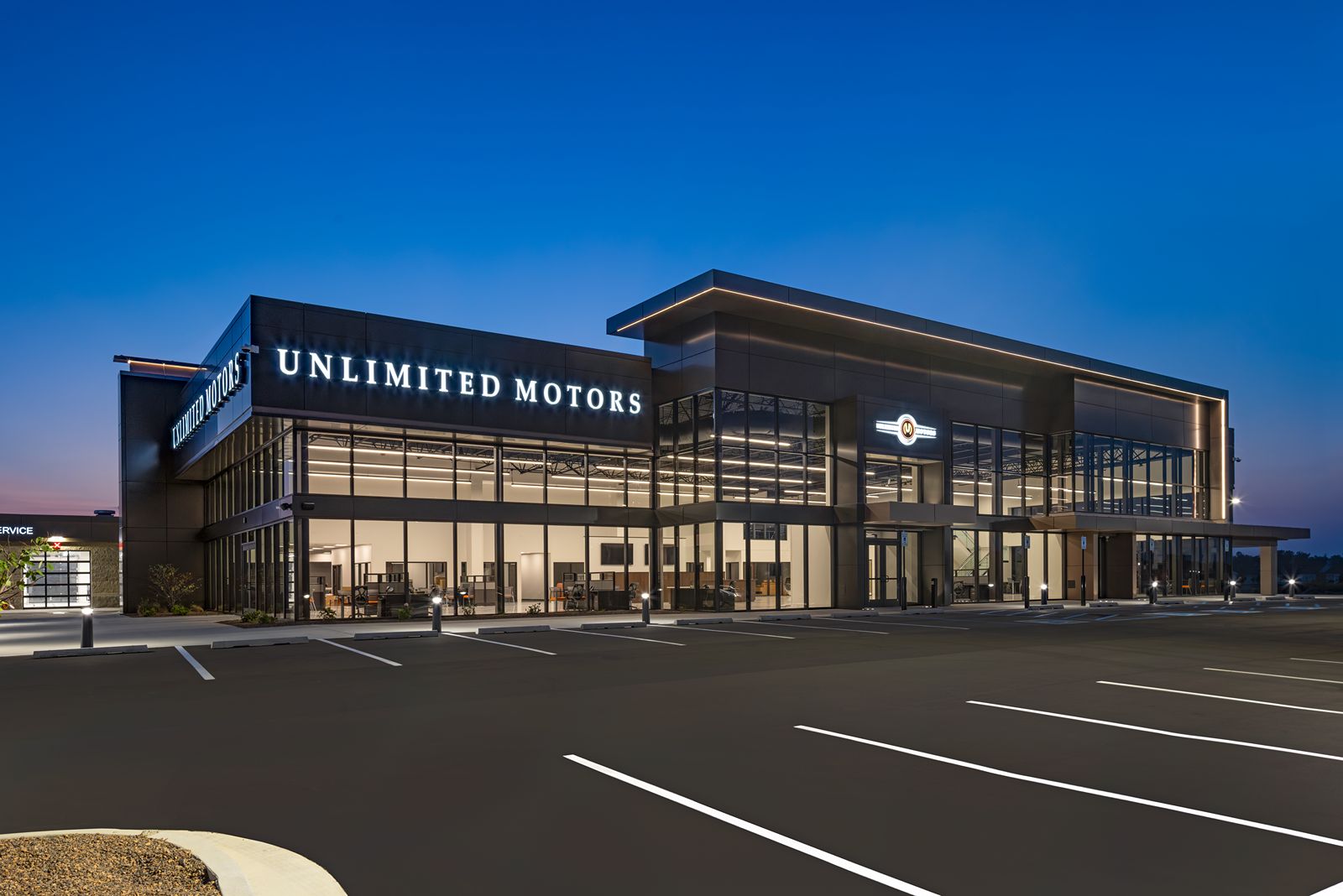
Courtesy Automotive Group, which operates Toyota, Ford, and Chevrolet dealerships across the Mobile, Alabama market, manages some of the Gulf Coast's most visible commercial roofing challenges: large showrooms with extensive glass lines, service department buildings with multiple HVAC penetrations and exhaust systems, and parts and detail facilities that operate continuously with vehicles and equipment under the roof. Roofing an active auto dealership in Mobile requires protecting an operation that cannot close, managing around customer-facing glass and canopy systems, and building to wind resistance standards appropriate for a market that sees at least one named storm per generation that tests everything the building code requires.
Dealership showrooms present a specific roofing challenge because of their large, continuously glazed storefronts and clerestory windows. The transition between the glass curtain wall and the flat roof membrane is one of the most common failure points on showroom buildings, and it fails because the expansion and contraction of the glass system and the roof membrane are different. We design all curtain wall to roof transitions with flexible counter-flashings that accommodate movement in both directions, and we test the assembly with a water infiltration simulation before declaring the transition complete. A showroom with a leak at the glass-to-roof interface is a customer experience problem, not just a maintenance issue.
Service department roofs in Mobile have to accommodate a density of HVAC equipment, exhaust fans, and make-up air units that exceeds almost any other commercial building type. The constant operation of vehicle exhaust systems in the service bays creates thermal and chemical demands on the roof membrane near penetrations that are more aggressive than typical commercial use. We specify high-temperature-rated membrane material at and around all exhaust fan curbs, and we detail the curb cap flashing with stainless steel in areas where exhaust temperatures regularly exceed ambient.
Salt air corrosion is a meaningful factor for Mobile dealerships within a few miles of Mobile Bay. Metal roofing components, copings, through-wall flashings, gutter systems, and equipment curbs, corrode faster in the salt-laden coastal air, and the galvanized steel components that perform adequately in inland markets may need to be upgraded to coated aluminum or stainless steel for coastal Mobile locations. We review the corrosion exposure of every Mobile dealership site and specify accordingly, because a coping that fails due to corrosion in year seven creates a water intrusion problem that costs ten times what the upgrade would have.
Occupied operations are the baseline condition for every dealership re-roof, which means no disruption to the showroom customer experience, no closure of service bays, and no interruption to the parts delivery cycle that keeps the service operation running. We work with dealership management to schedule work phases around the busiest service periods, avoid opening roof sections over showroom areas during business hours, and maintain a clean, professional appearance at the construction boundary at all times. A customer who drives up for a service appointment and sees a professional, well-organized roofing operation understands what they are seeing; a customer who sees debris and disorganization draws different conclusions about the dealership's management standards.
Hurricane preparedness for Mobile dealerships includes not just the roof membrane but the canopy systems that cover customer drop-off areas and the multi-level parking structures some larger dealers maintain. We coordinate with the dealership facilities manager on canopy attachment details and recommend any upgrades to anchor systems that are marginal for the design wind speed. A canopy failure during a storm that damages customer vehicles is a liability event of a different order than a membrane failure.
Mobile's building permit process for commercial dealership re-roofing requires a licensed contractor, a permit application, and inspections at key stages. The City of Mobile Building Inspections Department processes commercial permits, and our project team manages all permit activity as part of the project scope. We maintain copies of all inspection records for the dealership's property files.
The roofing membrane choice for Mobile dealerships typically comes down to TPO versus EPDM for the flat sections, with standing-seam metal on sloped canopy and entry areas. Both membrane types handle Mobile's humidity and wind loads when properly installed. The showroom sections benefit from a white TPO membrane because the cool roof surface reduces the heat gain into the showroom, lowering the air conditioning load in a market where cooling season runs nine months of the year.
Auto dealership real estate in Mobile represents significant capital investment, and the roof system is one of the few building components that protects the entire inventory and service operation simultaneously. A properly specified, properly installed, and properly warranted roof system on a Mobile dealership is the protection layer that allows everything else to operate as intended, through hurricane season and beyond.
- How do you protect a showroom's glass-to-roof transition in a Mobile dealership re-roof?
- We use flexible counter-flashings designed to accommodate differential movement between the curtain wall and the membrane, and we conduct water infiltration testing on every showroom transition before completion.
- What membrane specification handles Mobile's salt air corrosion risk?
- We upgrade all metal components, copings, flashings, gutter systems, and curbs, to coated aluminum or stainless steel for Mobile coastal sites, replacing galvanized components that corrode prematurely in salt-laden Gulf air.
- How do you re-roof an active service department without closing it?
- We phase work to maintain all service bay access and schedule overhead work during off-peak hours when possible. No roof section above an active bay is opened without a temporary protection system in place and a same-day close-out commitment.
- What wind resistance standard applies to Mobile auto dealerships?
- Mobile coastal-zone design wind speeds require fully adhered assemblies with tested uplift ratings. We calculate zone-specific pressures for showroom, service, and canopy sections and specify tested systems for each.
- How long does a Mobile dealership re-roof typically take?
- A standard dealership campus, showroom, service, parts, and canopy sections, typically takes two to three weeks with a full crew, phased to maintain all operations throughout.