
Reading an Acre of Roof Without Walking It
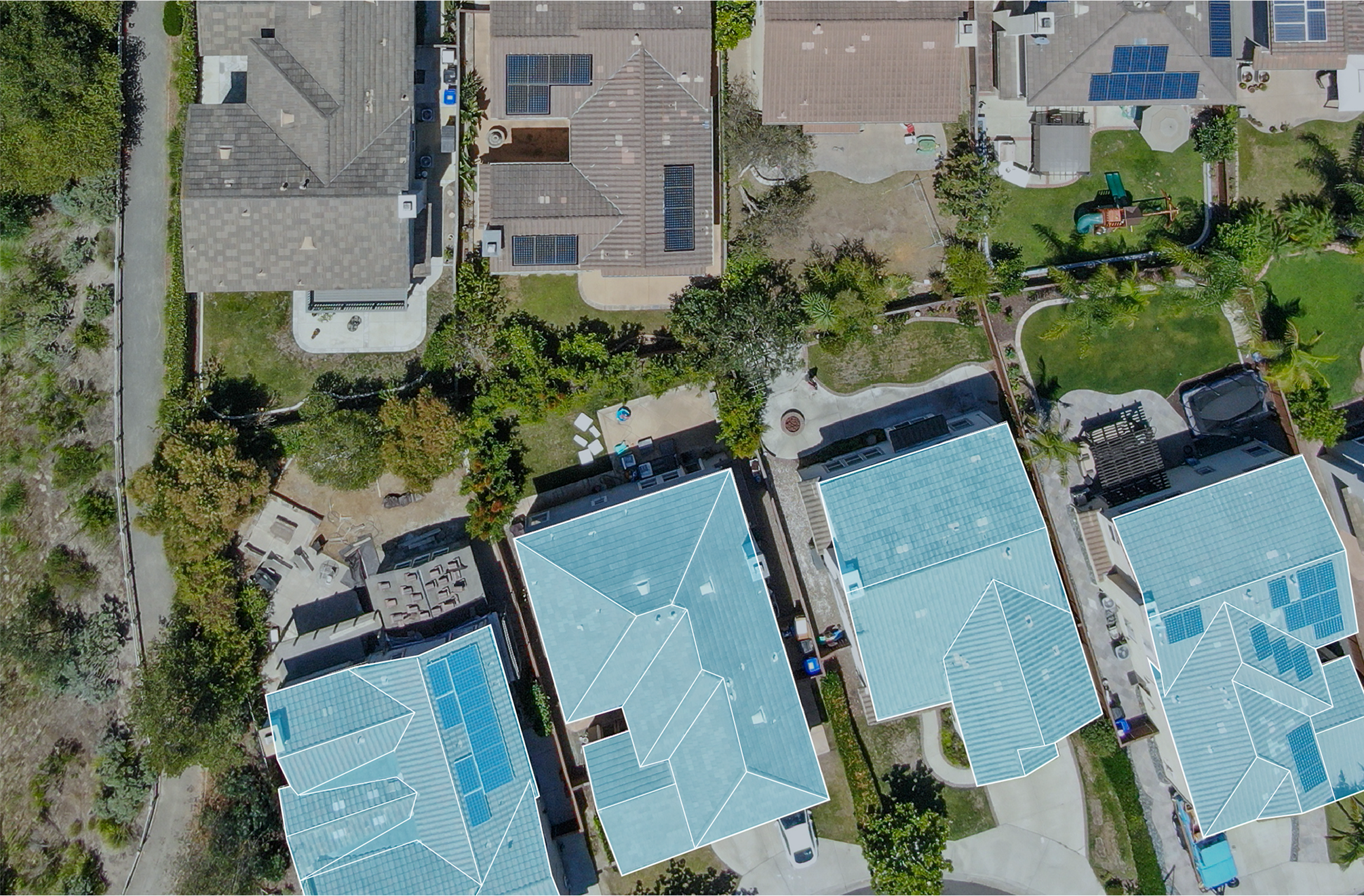
A 200,000-square-foot warehouse roof does not surrender its problems to a person on foot. The wet insulation, the early seam separations, the failing drain sumps, they are scattered across acres of membrane, and an inspector walking it sees a slice of the whole while putting traffic on a surface that may already be failing. We inspect large commercial roofs across Mobile from the air, pairing high-resolution aerial photography with infrared thermal imaging so the entire roof gets read in one consistent pass. For the distribution centers near Theodore Industrial Park, the logistics buildings serving the Port of Mobile and the Brookley Aeroplex, and the big retail boxes along Airport Boulevard, a drone survey produces a complete, repeatable record in a fraction of the time a manual walkover takes.
Speed is not the only reason. A drone holds a fixed altitude and overlap pattern, so the imagery covers every drain basin, expansion joint, curb, and penetration on a uniform grid rather than wherever one inspector happened to step. We stitch that into an orthomosaic of the whole roof and lay the thermal data over it. What the owner gets back is documentation you can build a capital plan around, not a verbal rundown of the few spots someone got close to.
Where the Real Value Is: Finding Moisture That Is Already In the Roof
The single most important thing any roof inspection can find is water that has already worked its way into the assembly, because that is the failure that quietly rots insulation and corrodes the deck while the membrane on top still looks fine. Thermal imaging surfaces it with no core cutting as the first step. Wet insulation carries far more thermal mass than dry insulation, so after a sunny day it holds heat long past sunset while the dry roof around it gives its heat back to the sky. We fly the infrared pass during that evening cool-down, and the saturated zones glow as warm patches against a cooler field.
That matters enormously in Mobile's hot, humid Gulf Coast climate, where moisture pushes into roof assemblies through small membrane breaches, failed penetration seals, and vapor drive off the conditioned interior. By the time a leak finally stains a ceiling tile inside, the wet area in the roof is usually many times bigger than the drip below it suggests. The thermal map shows the true footprint of the saturation, and that footprint is what tells us whether you are looking at a targeted cut-and-patch or a section that has to come off and be rebuilt. We confirm the infrared findings with a handful of verification cuts at the flagged spots, so the moisture map is backed by physical cores before any expensive decision rides on it.
Storm Claims Need Documentation Before the Next Rain
Mobile takes direct hits from Gulf tropical systems, and the wind and hail they bring leave commercial roofs needing fast, defensible documentation for insurance. After a storm we fly the roof and build a geotagged photo record: hail bruising and its density across the field, wind-peeled or displaced membrane, lifted or torn edge metal, and impact to rooftop HVAC and other equipment. Every frame is tagged to its location on the roof, so an adjuster can review the claim remotely and see exactly where each defect sits.
Capturing that record early is what protects the claim, because a roof left open after a storm keeps taking on water, and the argument over storm damage versus pre-existing wear only gets harder as the weeks pass. We prioritize post-storm flights and can assemble a claim package quickly after a significant event, formatted the way commercial property carriers expect to receive it. If the roof needs emergency stabilization first, we can document the damage and dry it in on the same visit so the building stops getting worse while the paperwork moves.
FAA Part 107 and Mobile's Very Real Airspace
Commercial drone work is regulated, and we treat it that way. Our inspection flights run under the FAA's Part 107 rules for small unmanned aircraft, flown by a certificated remote pilot inside the operating limits those rules set. Mobile's sky is busy: the Mobile Aeroplex at Brookley sits just south of downtown with the Airbus final assembly line operating there, Mobile Regional Airport serves the west side, and the Port adds its own activity. We check the controlled-airspace boundaries before every flight and pull the required FAA authorization wherever one is needed, rather than putting an aircraft up near an active runway environment on a hope.
Safety on the ground counts as much as the airspace. Many of the roofs we inspect sit on open, occupied buildings, with employees, customer traffic, and the public moving around them. We plan flight paths and the launch and recovery zones to keep the aircraft clear of people below, coordinate access with the facility, and time the flight to limit disruption to the operation underneath. The entire point of an aerial inspection is assessing the roof without sending a crew up onto an unknown surface, so doing it legally and safely is not a side note, it is the service.
Cleaner Reroof Bids and a Capital Plan You Can Fund
Beyond diagnostics and claims, drone surveys make replacement projects run straighter. Before we write a reroof specification, an aerial survey verifies the actual roof area, locates and counts every penetration and curb, and documents existing conditions accurately. That means the bid is built on what is genuinely up there instead of assumptions, which is what cuts the change orders and mid-tear-off surprises that drive up the cost of a Mobile commercial reroof.
For owners running several buildings, periodic thermal surveys turn roof maintenance into a planned program instead of a string of emergencies. Catching a wet area while it is still a few hundred square feet, before it spreads and rusts the deck, is the difference between a maintenance line item and a forced capital project. We deliver each inspection as a written report with the aerial map, the thermal findings, the verification cuts, and a prioritized list separating what needs attention now from what can be budgeted for a future cycle. Flown on a regular interval, the same roof gets compared year over year, so a slow-creeping wet area shows up in the data long before it becomes the leak that shuts a department down. For a Mobile owner with capital spread across a portfolio, that turns roof spending from a series of surprises into a schedule you can plan and pay for.