
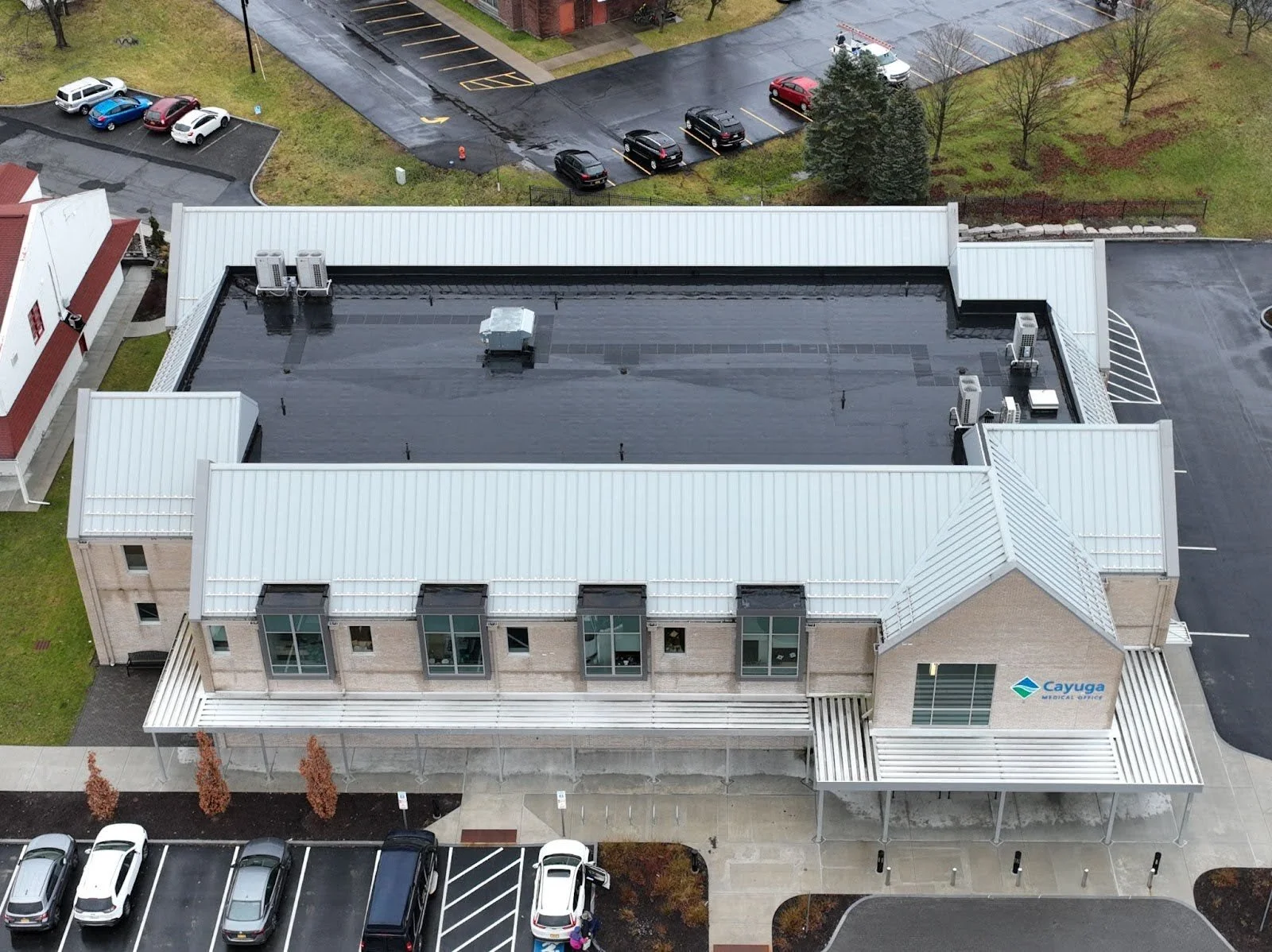
USA Health University Hospital, the flagship academic medical center of the University of South Alabama health system, anchors the medical district of Mobile with a complex of interconnected buildings that represent exactly the kind of 24/7 occupied, infection-sensitive, continuously operational environment that makes healthcare roofing the most technically demanding category of commercial roofing work. Medical facilities throughout Mobile County, from the hospital campuses of Spring Hill Medical Center and Infirmary Health to the ambulatory care buildings and medical office complexes that support them, require roofing contractors with specific healthcare expertise rather than general commercial roofers who have never worked on a live medical campus. Our team specializes exclusively in healthcare roofing and we bring that focused expertise to every project in this market.
The 24/7 operational reality of healthcare facilities is the foundation of every planning decision on a medical campus roofing project. Unlike an office building or retail center where work can proceed freely after business hours and on weekends, a hospital has no off hours, no unoccupied sections, and no periods when noise, vibration, dust, or odors can be simply tolerated as a construction nuisance. Patient safety, care continuity, and staff performance are all affected by construction activity, and a healthcare roofing contractor must have the protocols, the training, and the operational discipline to minimize those impacts to the greatest extent possible while completing necessary work.
Infection control is a non-negotiable requirement on healthcare roofing projects, particularly when work is performed above or adjacent to patient care areas, operating rooms, sterile processing facilities, or areas where immunocompromised patients are housed. Aspergillus and other mold species that are harmless to healthy people can be lethal to immunocompromised patients, and construction dust or debris that contains those organisms must be rigorously prevented from entering the building's air handling system or patient areas. We develop written Infection Control Risk Assessments for every healthcare roofing project, coordinate with the hospital's Infection Control Officer, and implement the physical barrier and air handling measures that the ICRA specifies.
Sterile environment protection extends to the physical conditions of the building envelope around operating suites, clean rooms, and sterile processing areas. Roofing penetrations, pipe sleeves, equipment curbs, conduit, drainage, that are improperly detailed can allow water infiltration that creates conditions for mold growth within the wall or ceiling assembly above a sterile area. We apply a higher standard of flashing quality and penetration sealing detail to every work area on a healthcare campus than we would to a standard commercial project, because the consequences of a failure are categorically more serious.
Regulatory compliance adds a layer of complexity to healthcare roofing that does not exist in other market segments. The Joint Commission, CMS Conditions of Participation, and Alabama Department of Public Health regulations all have implications for construction activities in healthcare settings. We are familiar with the regulatory framework that governs hospital construction and we design our work scopes, safety plans, and Infection Control Risk Assessments to comply with applicable regulatory requirements. Our construction activity documentation provides the records that healthcare compliance officers need to demonstrate regulatory compliance during inspections.
Mobile's Gulf Coast climate adds specific material selection considerations to the standard healthcare roofing requirements. High humidity levels that are a constant feature of the coastal Alabama environment create conditions where moisture infiltration from a failed roofing detail can support mold growth more rapidly than in drier climates. We specify moisture-resistant insulation facings, use mold-resistant adhesives and cover boards, and detail all penetrations and transitions to prevent moisture entry with a level of thoroughness that the healthcare environment demands.
Equipment integration is a complex challenge on hospital rooftops, which carry cooling towers, emergency generators, HVAC equipment, communication arrays, and other critical systems that must remain operational during roofing work. We develop detailed sequencing plans for working around rooftop equipment, coordinating with the hospital's facilities management team to ensure that equipment access, maintenance windows, and operational requirements are fully accommodated throughout the project. We have the experience to work around critical infrastructure without interrupting hospital operations.
After-hours work is sometimes the only option for the most sensitive phases of a healthcare roofing project, and we have the crew capacity and the project management infrastructure to execute night-shift roofing work when daytime access to critical areas is prohibited by patient care requirements. Night-shift work on a healthcare campus requires specific lighting, noise management, and coordination protocols that our team has developed through extensive experience on hospital projects.
From USA Health's main hospital campus to the ambulatory care buildings of the Spring Hill and Midtown medical corridors, our team brings the healthcare-specific expertise, the Infection Control Risk Assessment protocols, and the 24/7 operational discipline that Mobile's medical facilities deserve. We are licensed, insured, and equipped to serve as a trusted roofing partner for every healthcare property type in this market.
- What is an Infection Control Risk Assessment and why does it matter for hospital roofing?
- An ICRA is a formal written assessment that identifies which patient populations may be at risk from construction-related dust and debris, determines the physical controls required to protect them, and specifies the monitoring and documentation procedures that demonstrate those controls were maintained throughout the project. It is a standard requirement for construction activity in or near patient care areas in accredited healthcare facilities.
- How do you protect sterile areas like operating rooms during roofing work above them?
- We coordinate directly with the hospital's Facilities Management and Infection Control teams to implement the specific containment measures required by the ICRA for each sensitive area. Physical barriers, negative pressure containment, air filtration, and material handling protocols are all part of our standard practice for work above or adjacent to sterile or sensitive areas.
- How do you handle rooftop equipment that must remain operational during a roofing project?
- We develop detailed equipment sequencing plans in coordination with the hospital's facilities team before work begins. This includes mapping the location of all rooftop equipment, identifying maintenance access requirements, and scheduling roofing work to ensure continuous access to critical systems. We never restrict access to emergency equipment, HVAC units, or communication arrays without explicit advance coordination with facilities management.
- What roofing materials do you recommend for Mobile's Gulf Coast healthcare campuses?
- Reinforced white TPO with heat-welded seams is our standard recommendation for low-slope healthcare roofing in Mobile's climate. It provides the reflective surface that reduces cooling loads, the weld integrity that minimizes infiltration risk, and the moisture resistance that the Gulf Coast's high humidity environment demands. For steep-slope sections, standing seam metal with appropriate corrosion-resistant hardware is our recommendation.
- Do you have experience working under Joint Commission and CMS healthcare facility regulations?
- Yes. We are familiar with the Joint Commission's Environment of Care standards and CMS's Physical Environment Conditions of Participation, both of which have implications for construction activities in accredited healthcare facilities. Our ICRAs and project documentation are prepared with these regulatory frameworks in mind, and our healthcare project managers are trained to support the compliance documentation that healthcare clients require.