
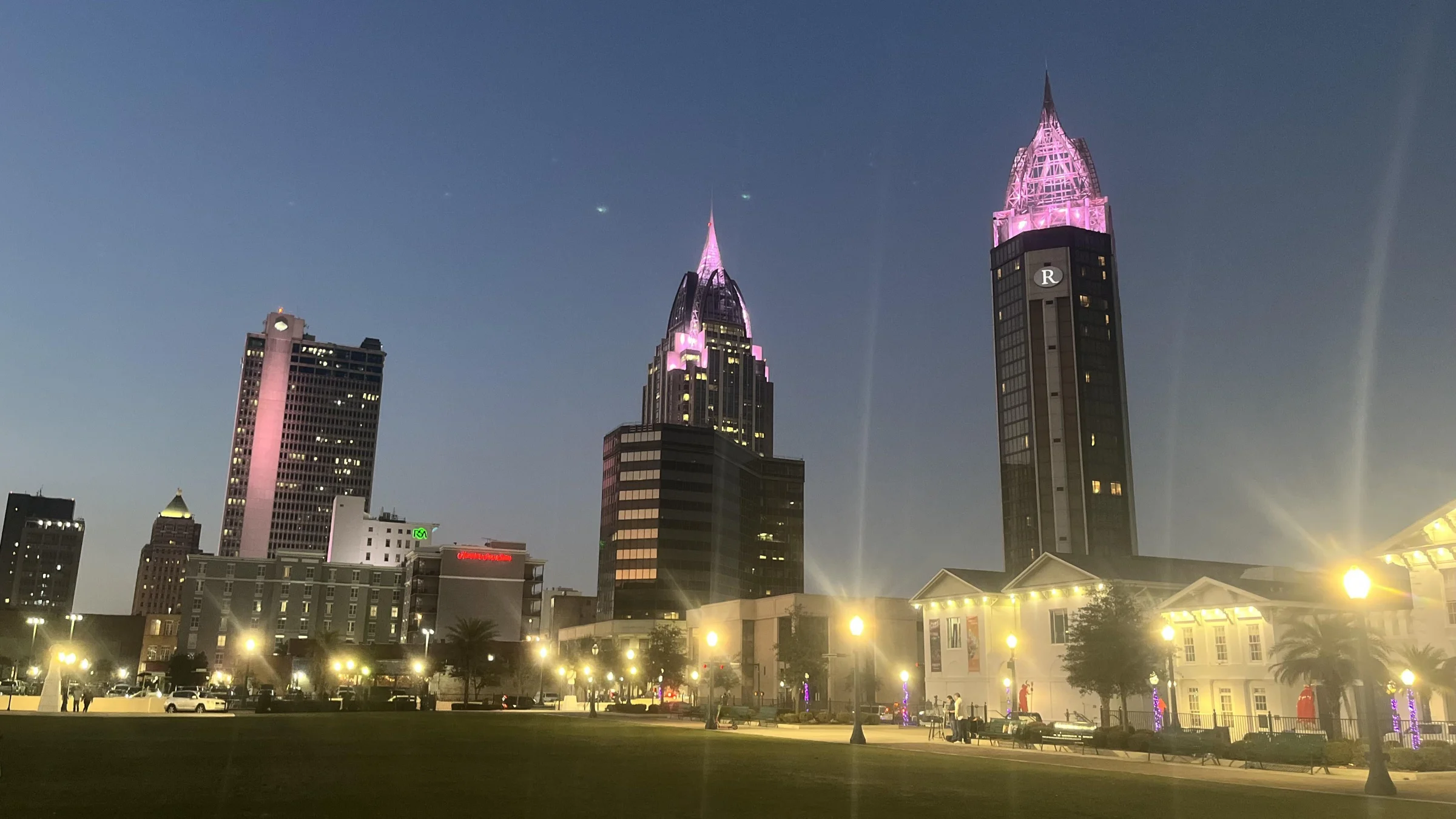
Mobile occupies a stretch of the Gulf Coast that has taken direct and near-direct hurricane hits repeatedly over the past few decades, systems making landfall along the Alabama and Mississippi coastline or tracking up Mobile Bay bring sustained wind, wind-driven rain, and often storm surge to the port, downtown, and the Eastern Shore communities alike. Whether a storm makes a direct hit on the bay or passes to the west or east, commercial roofs here take on wind and water stress that a standard repair claim doesn't usually involve.
Commercial property policies in this market often carry a separate named-storm deductible in addition to the standard all-other-perils deductible. That named-storm deductible is typically written as a percentage of the building's insured value rather than a flat dollar amount, and it applies once the National Hurricane Center or National Weather Service has assigned a name to the system, a different threshold than the wind or hail deductible that applies the rest of the year. The exact percentage and trigger language vary by policy, which is one more reason the documentation needs to match what the carrier is actually evaluating against.
Post-hurricane roof damage on Mobile's commercial buildings typically shows up as membrane displacement at laps and terminations, lifted or torn-off edge metal and coping, damaged parapet flashing, and wind-driven rain intrusion at rooftop penetrations and curb flashings, sometimes before any interior leak is visible. Port of Mobile and Brookley-area industrial roofs, with large open membrane fields and heavy rooftop equipment loads, tend to show wind uplift at the field and around curbs first. Downtown historic buildings with parapet walls and older flashing details often show water intrusion at the wall-to-roof transition before the membrane itself shows obvious damage.
We inspect the roof after a storm, photograph and measure the damage, and produce a written assessment that documents the wind and water intrusion pattern across the full roof, beyond the section where a leak first appeared inside the building. That documentation is built to support a joint inspection with your adjuster and to give your broker or claims team an accurate, dated record of storm impact.
We're your roofing contractor, not a public adjuster, we document and substantiate the roof damage so you and your adjuster work from an accurate scope. We don't file claims, negotiate settlements, or guarantee a payout amount; those decisions rest with the property owner, their broker, and the carrier.
Hurricane Roof Insurance Claim Questions
Does a named-storm deductible apply differently than a normal wind deductible?
On many Gulf Coast commercial policies, yes. A named-storm deductible is usually written as a percentage of the building's insured value rather than a flat dollar figure, and it applies once a system is officially named, separate from the deductible used for non-named wind or hail events. Confirm the exact trigger and percentage with your broker, since policy language varies.
How soon after a hurricane should the roof be inspected?
As soon as it's safe to access the property. Wind-driven rain can enter through lifted flashing or displaced membrane well before a leak shows up inside, so an early inspection catches damage before it compounds into interior and structural issues. We prioritize post-storm inspection requests across Mobile and Baldwin counties.
Will my roof need full replacement after a hurricane?
Not always. That depends on how much of the membrane, insulation, and deck are affected, the roof's age going into the storm, and the policy's repair-versus-replace terms. We document the physical condition; the coverage decision is made between the owner and the carrier.
Can you inspect the roof before the adjuster arrives?
Yes, and we recommend it after any hurricane or tropical system that produces sustained wind at the property. An independent, dated inspection record is useful if roof conditions change before the carrier's adjuster can get on site, which happens often in the days after a major landfall.
What should be done before hurricane season to protect the roof and the claim?
A pre-season inspection that documents baseline roof condition, existing wear, prior repair patches, loose edge metal, gives a clear before-and-after comparison if a storm causes damage. That comparison makes post-storm documentation faster to produce and easier for an adjuster to evaluate.