
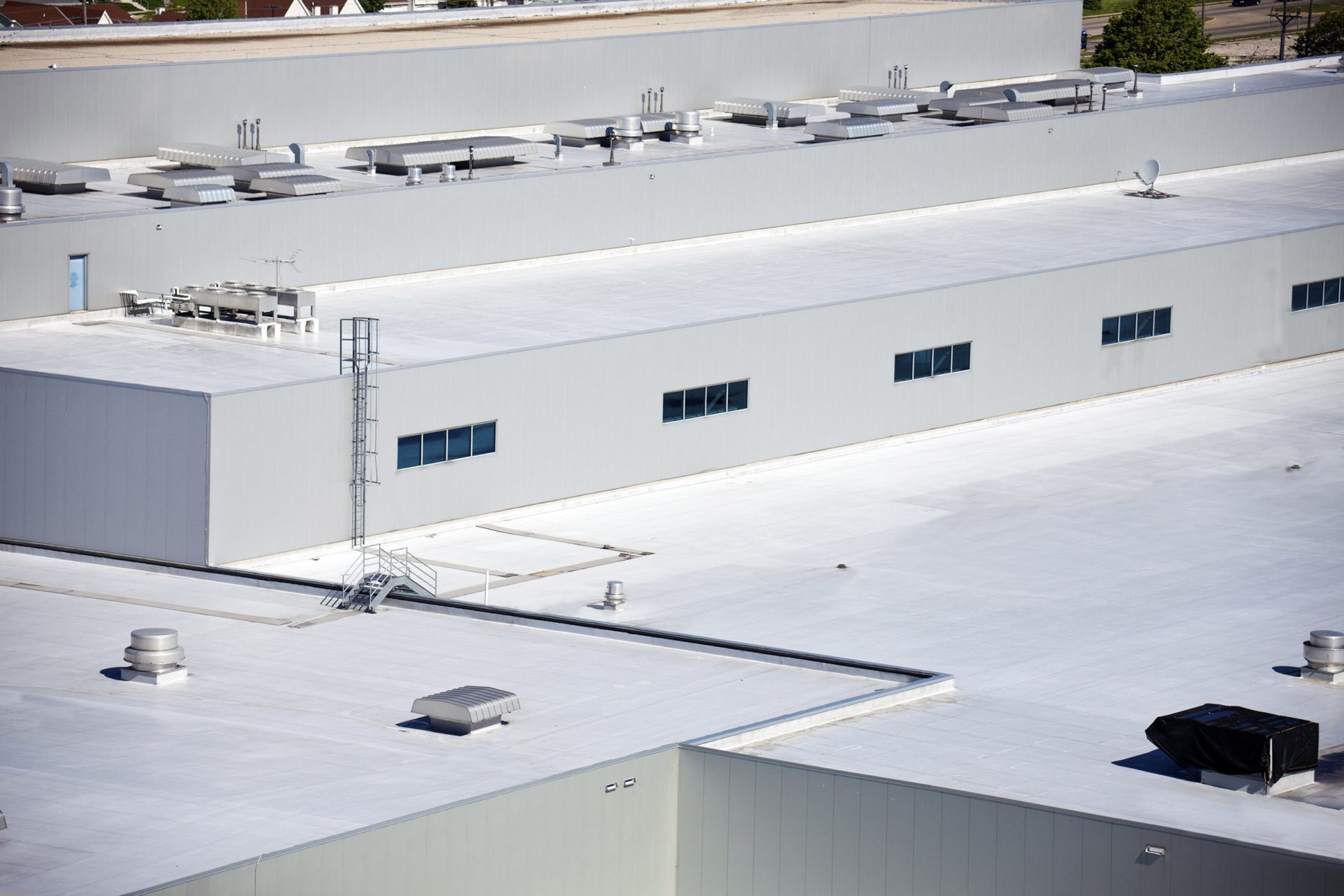
Airbus Americas' final assembly facility in Mobile, Alabama stands as one of the most demanding commercial roofing environments on the Gulf Coast. The A220 and A320-family jets assembled at the Mobile Aeroplex at Brookley require roof systems capable of withstanding coastal humidity, tropical storm loads, and the complex chemical environment generated by aerospace manufacturing processes. Commercial roofing contractors serving Mobile's industrial waterfront must understand how hydraulic fluids, composite resins, and cleaning solvents interact with membrane materials over time, because a single incompatible product can void a manufacturer's warranty and compromise a roof system worth hundreds of thousands of dollars.
Process equipment at aerospace and manufacturing facilities along Mobile Bay generates vibration profiles that most commercial roofers never encounter. Heavy-lift cranes, rivet machines, and fuselage-positioning gantries transmit structural vibration through building frames and into roof decks continuously during production shifts. Roofing systems installed in these environments must accommodate micro-movement at every penetration, seam, and fastener point. Contractors experienced with Mobile's manufacturing sector use isolation mounts for rooftop mechanical equipment and apply extra sealant passes at all structural transitions to prevent fatigue cracking that standard installations would never anticipate.
ThyssenKrupp's former steel operations and the current industrial tenants occupying those sites along the Mobile River corridor present a different set of challenges: heavy industrial exhaust, acidic condensate from metal processing, and the physical weight of rooftop ventilation systems designed for continuous operation. Elastomeric coatings that perform well in office environments can degrade within 18 months when exposed to the exhaust chemistry common in metals fabrication. Mobile roofing teams working in this sector maintain a reference library of chemical compatibility data and submit samples for laboratory testing before specifying any coating on an active production facility.
Natural light management is a major concern for large-span manufacturing buildings throughout Mobile County. Skylights and translucent roof panels reduce artificial lighting costs substantially, but they require precise detailing where polycarbonate or fiberglass panels meet the primary membrane. Thermal expansion differentials between metal decking, insulation board, and translucent panels create cyclical stress at curb flashings that can open leak paths within three to five years if the original installation used rigid sealants. Mobile contractors working on manufacturing roofs now specify flexible butyl-based flashings at all skylight curbs and schedule re-inspection of those transitions every 24 months.
Schedule coordination at active manufacturing plants in Mobile requires a level of planning discipline that goes beyond standard commercial roofing project management. Airbus and the automotive suppliers operating in the Brookley complex run two- and three-shift production schedules that make it nearly impossible to allow roofing crews unrestricted access during business hours. Effective project teams segment work into zones aligned with production areas, coordinate with facility safety managers to obtain hot-work permits on a daily basis, and maintain detailed documentation of every material staged on the roof to comply with facility security requirements.
Storm preparation is a year-round operational reality for manufacturing plant roofs in Mobile. The city sits within the Gulf Coast hurricane zone, and facilities with large unbroken roof planes are particularly vulnerable to uplift loading during named storms. Modern commercial roofing standards call for perimeter and corner zones to receive fastener densities two to three times higher than field areas, but older manufacturing buildings in the Brookley complex and along the causeway frequently have legacy roof systems installed before current wind-uplift codes were adopted. Re-roofing projects on these structures require full engineering analysis and often involve additional structural reinforcement at parapet walls before new membrane systems can be installed.
Insulation decisions on manufacturing roofs in Mobile's humid subtropical climate involve tradeoffs that are unique to this region. High interior humidity from industrial processes combined with high ambient outdoor humidity for eight months of the year creates vapor drive conditions that can cause conventional polyisocyanurate insulation to absorb moisture and lose R-value. Mobile's experienced industrial roofers have shifted toward closed-cell spray polyurethane foam as a base layer on re-roofing projects where the existing deck shows any evidence of prior moisture intrusion, because the foam seals the deck while adding meaningful thermal resistance in a single application.
Maintenance programs for manufacturing plant roofs in Mobile should account for the rapid growth of biological organisms on roof surfaces during the wet season. Algae, moss, and lichen colonize reflective membranes and coatings quickly in the Mobile climate, reducing solar reflectance and accelerating membrane degradation. Biocide treatments applied as part of an annual roof maintenance program extend coating life by three to five years on average and help facilities maintain the solar reflectance values required for ENERGY STAR certification and local utility rebate programs.
Capital planning for manufacturing roof assets in Mobile benefits from a formal roof asset management program that tracks the age, condition, and remaining service life of every roof section across a facility. Large plants like those at the Aeroplex often have roofs installed in phases over decades, meaning that different sections may be on entirely different replacement timelines. A current roof condition assessment gives facility managers the data they need to budget accurately, prioritize emergency-risk sections for early replacement, and negotiate multi-year service agreements with roofing contractors that reduce per-square costs through volume pricing.
- What roofing membrane is best for aerospace manufacturing plants in Mobile?
- TPO and EPDM membranes both perform well in Mobile's climate, but facilities with significant chemical exposure from composite resins or hydraulic fluids often benefit from a fleece-backed TPO or a coating-protected EPDM that adds a sacrificial layer resistant to petroleum-based compounds. A chemical compatibility test with actual facility solvents should precede any final specification.
- How do you schedule a re-roofing project at a 24/7 manufacturing facility?
- The most effective approach divides the roof into production-zone-aligned work areas and establishes a phased schedule with facility management. Night-shift and weekend access is common, and daily hot-work permit coordination is standard practice. Thorough pre-project planning with the safety team prevents costly delays once work begins.
- Can skylights be maintained on an active production line roof?
- Yes, but all skylight work requires fall protection planning and temporary protection over the production area below. Contractors use debris nets and hard covers over active lines while performing curb flashing replacements. Work is typically sequenced to coincide with planned production downtime to minimize risk.
- How often should a manufacturing plant roof in Mobile be inspected?
- Twice-yearly inspections, typically in spring before hurricane season and in fall after it, are the minimum standard for manufacturing facilities. High-chemical-exposure roofs and those with large numbers of penetrations benefit from quarterly walkthroughs by a trained technician.
- What wind-uplift rating should a new manufacturing roof in Mobile meet?
- Mobile County falls within a high-wind zone, and current International Building Code requirements as adopted in Alabama require manufacturing roofs to meet FM Global 1-90 or 1-105 ratings at a minimum. New construction in exposed coastal locations near Mobile Bay should be engineered to 1-135 or higher given the frequency of strong Gulf storm events.