
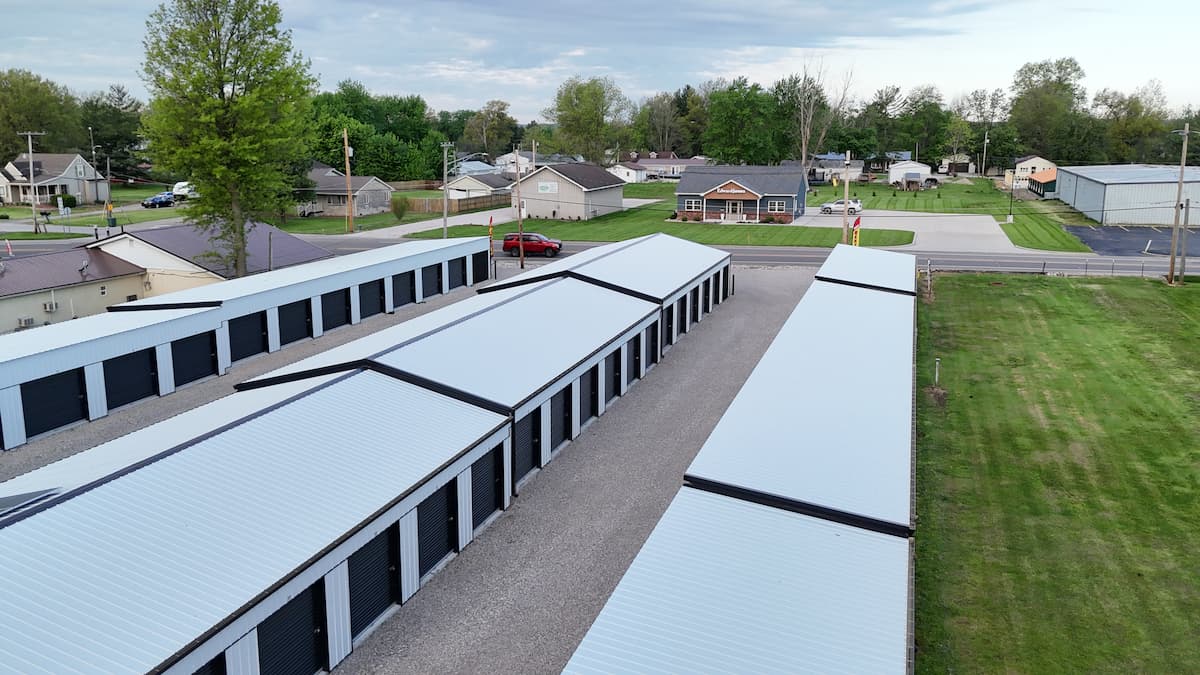
Public Storage on Airport Boulevard in Mobile, Alabama operates one of the Gulf Coast's largest self-storage campuses, with dozens of single-story metal buildings spanning several acres. Managing roof systems across that kind of footprint requires a roofing contractor who understands both the volume and the vulnerability. Mobile sits squarely in hurricane territory, and every square foot of a storage facility's envelope is exposed to the same Category-3 or Category-4 winds that hammered the region during Hurricane Sally in 2020. A commercial roofing team working in Mobile must treat every self-storage roof as a wind uplift problem first and everything else second.
The sheer footprint of a self-storage campus creates drainage challenges that single-building commercial jobs rarely face. When you have eight to twelve parallel buildings with valley gutters running between them, a partial blockage during a tropical downpour can back water under panels, saturate insulation, and migrate into tenant units within hours. Our crews survey every interior valley and perimeter drain before touching materials, clearing debris and re-sloping low spots that have settled over years of thermal cycling. Getting drainage right the first time prevents tenant claims, REIT liability exposure, and emergency call-outs at 2 a.m. during a named storm.
Mobile's humidity is relentless from April through October, and standing moisture on low-slope roofs accelerates fastener corrosion on metal panel systems faster than almost anywhere outside coastal Louisiana. We spec stainless or hot-dipped galvanized fasteners as standard on every Mobile job, and we use closed-cell foam backer rod at all panel laps before applying sealant. This detail adds modest cost upfront but eliminates the rust streaking and panel separation that show up within five years on budget re-roof jobs that skip it.
TPO and standing-seam metal are the two dominant choices for self-storage roofs in Mobile, and each has a legitimate place depending on the building age, deck condition, and owner's hold period. Single-ply TPO on a 60-mil membrane gives you a fully adhered, weldable system that performs well against wind uplift when installed with a tested assembly. Standing-seam metal with concealed fasteners is the longer-term play for owners who plan to hold a portfolio asset for fifteen or twenty years, because there are no exposed fasteners to back out and no seams that rely on adhesive bond.
Tenant protection is not an abstraction on a self-storage re-roof. Tenants store furniture, electronics, documents, and irreplaceable personal items. A phased re-roofing plan that takes one building offline at a time, notifies tenants in writing before work begins, and provides temporary covers over any open decking after 2 p.m. each day is the professional standard. We provide that documentation as part of our project package so facility managers can communicate proactively rather than reactively when a tenant calls asking what the noise is.
Mobile's building code adopted updated wind provisions after the 2004–2005 hurricane seasons, and current IBC-based requirements for coastal Alabama specify higher design pressures at corners and perimeter zones. Our estimators pull the local wind speed map and calculate the required uplift resistance for each zone before specifying fastener patterns or membrane adhesion rates. Pulling a permit and getting a passing inspection on a Mobile self-storage roof means showing your work on the engineering side, and we carry all required documentation in every permit submittal package.
Climate-controlled self-storage units add another layer of complexity. These buildings have HVAC penetrations, condensate lines, and sometimes rooftop package units that create more opportunities for water intrusion than a standard drive-up unit building. Every penetration gets a custom-fabricated metal sleeve, a self-healing membrane patch, and a clamped pitch pocket where geometry demands it. We photograph every penetration detail before and after installation as part of the warranty documentation package.
The roof warranty conversation is worth having carefully with any Mobile storage operator. Most manufacturer warranties on single-ply systems are void if the installer is not a certified applicator, and many are voided by subsequent trade work that cuts through the membrane for HVAC or electrical without following the manufacturer's repair protocol. We register every warranty directly with the manufacturer and provide the facility manager with a written protocol for future penetrations so that one HVAC call-out five years from now does not quietly void a twenty-year guarantee.
Mobile's market for self-storage is competitive, and the difference between a facility that commands premium rents and one that competes on price often comes down to visible condition. A clean, uniform roof with consistent color and no visible rust or ponding reads as a well-managed property to prospective tenants and institutional buyers alike. Our work in Mobile is designed to hold up to that scrutiny year after year, in the heat, the humidity, and the storms that come with operating on the Gulf Coast.
- What roofing membrane performs best on Mobile self-storage buildings?
- 60-mil TPO with a fully adhered assembly and stainless fasteners at all terminations performs best given Mobile's combination of wind uplift risk and humidity. Standing-seam metal is a strong alternative for owners with a long hold horizon.
- How do you protect tenant belongings during a re-roof?
- We phase work one building at a time, provide written tenant notice before each phase begins, and install temporary protective covers over any open decking each afternoon before the crew leaves the site.
- Are special permits required for self-storage roofing in Mobile?
- Yes. Mobile County and the City of Mobile require commercial roofing permits, and coastal wind-zone projects must include documentation of the tested uplift assembly. We handle all permit submittals as part of our project scope.
- How do you handle the valley gutters between parallel storage buildings?
- We survey every valley gutter for slope, debris, and corrosion before starting work, re-slope settled sections, replace corroded liner sections, and install debris guards at all downspout entries to reduce maintenance frequency.
- Does Mobile's hurricane season affect your scheduling?
- We plan self-storage re-roofs to complete membrane work between October and May when possible, and we always maintain a detailed storm protocol so any partially completed roof can be secured within two hours of a weather warning.