
The Roof Is the Foundation of Every Rooftop Solar Array
Panels get the attention, but the membrane underneath is what decides whether a Mobile solar project lasts. A photovoltaic system is designed to produce for two and a half to three decades, and it can only do that if the roof it sits on is good for the same stretch. We handle the roofing side of commercial solar across Mobile: confirming the deck and membrane can host an array, detailing every place the racking touches the roof, and keeping your existing manufacturer warranty alive through the install. We are not selling you modules or inverters. We are making sure the surface they bolt to does not become the weak link.
The buildings that pencil out for solar here are the ones with broad, sun-exposed low-slope roofs and few obstructions. Think the distribution and logistics space around Theodore Industrial Park, the fulfillment and warehouse buildings tied to the Port of Mobile and the Brookley Aeroplex, and the wide retail rooftops strung along Airport Boulevard and out toward Schillinger Road. Those same flat acres of membrane are where racking anchors, ballast weight, and material compatibility get done correctly or quietly set up a leak. Our job is to make sure it is the former.
Start By Asking How Much Life the Membrane Has Left
The most costly error in commercial solar is mounting a twenty-five-year array onto a roof with six or seven years left. When that membrane reaches the end, every panel, rail, conductor, and combiner has to come off, the roof gets torn off and rebuilt, and the whole system goes back up. That removal-and-reset adds real money to a reroof and parks the array offline for weeks while it happens. So before anyone sizes a system, we want to know what the existing roof actually has in the tank.
We answer that with core cuts to read insulation condition and attachment, a survey of seams and prior patches, an infrared scan to find any moisture already trapped in the assembly, and a look at the deck and structure. If the roof has fifteen or more sound years ahead, mounting on it is a defensible call. If it is in the last third of its life, the honest move is to reroof first and set solar onto a fresh, fully warranted membrane. We give Mobile owners that remaining-life figure in writing so the solar payback model rests on the real roof, not wishful thinking.
Penetrations, Ballast, and Matching the Attachment to Your Membrane
Low-slope solar around here lands on the roof one of two ways, and each one treats the membrane differently. Ballasted racking weighs the array down with concrete blocks or pavers and ideally never punctures the roof, holding position through mass and friction. Mechanically attached racking fastens the rails to the structure through the membrane at set intervals. On a Gulf Coast roof facing tropical wind, pure ballast is frequently not enough on its own, so hybrid layouts add anchored points at the array's perimeter and corners where uplift pressure peaks.
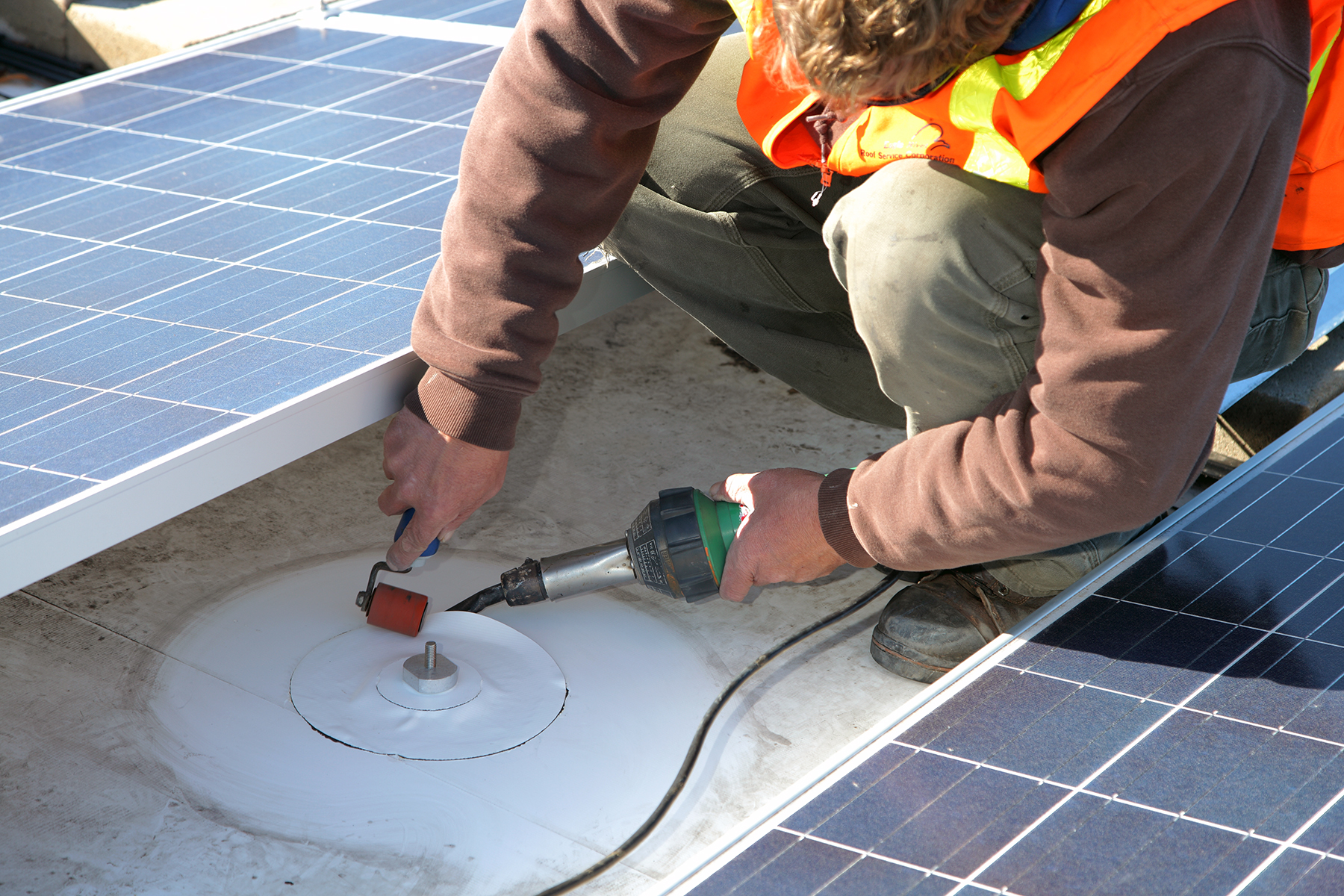
Every anchored standoff is a hole in your roof, and every hole needs a flashing detail built for the membrane it lands in. A TPO or PVC roof gets a hot-air-welded target patch or a manufacturer-approved post boot; a built-up or modified-bitumen roof gets an entirely different, mastic-and-ply detail. We verify the racking vendor's standoff hardware is compatible with your membrane chemistry before a single fastener goes in, because the wrong sealant or an unwelded penetration on a thermoplastic roof is a leak waiting for the first hard rain off Mobile Bay. The DC and AC conduit runs crossing the roof are penetrations too, so we flash them, support them on approved bases, and route them so they do not chew through the membrane as the roof expands and contracts with the heat.
Weight on the Deck, Uplift in the Storm
Solar changes two things at once: it adds dead load and it rewrites how wind moves across the roof. A ballasted system can put several pounds per square foot onto the deck once the blocks are counted, and that has to be checked against the framing, especially on the older mid-century structures downtown and along the Lower Dauphin Street corridor that were engineered to lighter standards than today's code. We coordinate with the project's structural engineer so the ballast plan and panel layout match what the joists and deck can genuinely carry.
Uplift is the sharper issue on the Gulf Coast. Mobile sits in a high-wind, hurricane-exposed region, and a field of panels acts like a field of small wings when a storm comes through. The racking design has to account for the elevated uplift at the roof's edges and corners, the ballast or anchorage has to resist those pressures, and the perimeter edge metal has to hold so wind cannot get a grip under the array. We make certain the wind design for the solar system and the wind design for the roof edge are engineered together instead of in two separate silos that meet for the first time during a named storm.
Keeping Your Warranty Alive Across Two Trades
This is where commercial solar projects most often come apart. A membrane manufacturer's warranty generally requires that any rooftop attachment, penetration, or added equipment be installed to their spec and, in many cases, reviewed and approved by them beforehand. If a solar crew drills the roof and flashes its own penetrations without that sign-off, the manufacturer can void the warranty on the entire roof, not merely the patch under the panels. We run the manufacturer review so the solar attachments are pre-approved, documented, and registered before drilling starts.
We also draw a hard line on responsibility. The roofing scope owns the membrane, the penetration flashings, the walkway pads protecting the maintenance path to the array, and the watertightness of the whole assembly. The solar contractor owns the rails, modules, and electrical. When a leak shows up two years later, that documented split keeps the trades fixing the roof instead of blaming each other. For Mobile owners chasing the federal solar tax credit and an Alabama Power interconnection, a properly prepared roof with an intact warranty is what protects the asset those incentives were meant to reward.
How We Plug Into Your Solar Developer's Schedule
Bring us in at the proposal stage, before the array is sized, and the roof condition plus any needed reroof gets priced into the deal honestly instead of surfacing as a surprise mid-install. We hold a pre-construction meeting with the solar EPC to lock the penetration details, the conduit routing, the walkway layout, and the inspection sequence: membrane installed and inspected first, penetrations flashed by us, racking set next, then a joint final walk to register both warranties. If a solar company is courting you about your Mobile building right now, get us in the room early. We will tell you plainly whether your roof is ready, what it needs first, and what it takes to keep the system dry for its full service life.