
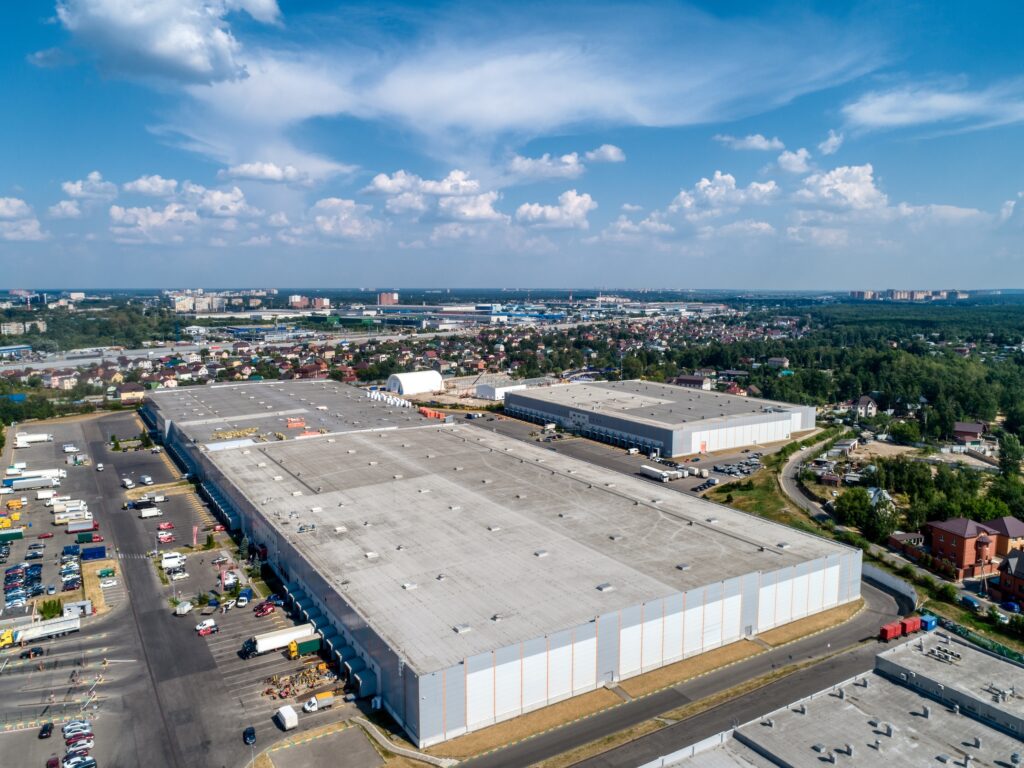
Gulftainer's container terminal and warehouse complex along the Port of Mobile's McDuffie Island represents the scale of industrial roofing demands that define this Gulf Coast city. Mobile's deep-water port handles millions of tons of cargo annually, and the cavernous distribution and storage buildings that line the waterfront and the corridors feeding I-65 north face roofing challenges that differ sharply from anything encountered in the interior United States. A commercial roofing contractor working on warehouse structures in Mobile must understand the interplay of hurricane-force wind uplift, relentless humidity, and the salt-laden marine atmosphere that accelerates membrane degradation in ways that standard product warranties rarely anticipate.
The fundamental drainage challenge on a large warehouse footprint in Mobile is not just volume, it is timing. When a Gulf hurricane or tropical storm stalls offshore and delivers twelve inches of rain in eighteen hours, a flat 200,000-square-foot roof can accumulate hundreds of thousands of gallons of standing water if interior drains are undersized or blocked. Every warehouse roofing project in Mobile should begin with a hydraulic load analysis that accounts for Alabama's 100-year storm intensity figures, which are among the highest in the continental United States. Drain bowls should be set a minimum of two inches below the surrounding deck surface, overflow scuppers sized to handle the event the primary drains cannot, and tapered insulation used to create at least one-quarter inch per foot of positive slope toward every drain.
TPO and EPDM are both viable single-ply membranes for Mobile warehouses, but the selection turns on specifics. TPO's heat-welded seams perform better in Mobile's intense UV exposure and high summer temperatures, where EPDM adhesive-bonded laps can soften and creep over time. However, a sixty-mil reinforced EPDM mechanically fastened system with factory-taped seams is an equally sound choice for owners who want a proven track record in hurricane-wind-uplift testing. What matters most is that whatever membrane is selected carries a Florida Building Code-approved uplift assembly, because Alabama has adopted equivalent uplift standards for commercial structures in coastal counties, and many insurers now require the documentation at policy renewal.
Dock penetrations are a persistent source of moisture intrusion in Mobile's warehouse stock. Loading dock canopy attachments, dock leveler pit curbs, and the conduit and compressed-air lines that run through roof decks at logistics facilities all require custom flashing details. The preferred approach uses a EPDM pitch pocket or a pre-formed TPO pipe boot with a compression ring, sealed with a two-part polyurethane sealant rated for continuous immersion, then covered with a fabricated sheet-metal cap. Any dock canopy wall flashing must extend a minimum of twelve inches above the finished roofing surface and terminate with a receiver reglet set into the wall, not surface-mounted, because salt-driven corrosion works behind surface-mounted reglets within a few seasons in this climate.
Forklift exhaust fans and rooftop HVAC equipment on cold-storage annexes create additional penetration management demands. Mobile's largest third-party logistics providers run propane-powered forklifts whose exhaust fans are often located directly in the warehouse ceiling and vent through the roof with very short stub stacks. These stubs rarely have adequate flashing clearance from the membrane. The standard fix is a minimum twelve-inch high curb, a spun-aluminum counter-flashing collar, and a heavy-duty EPDM boot with a stainless draw band. Cold-storage warehouse roof sections also require a thermal break detail at the parapet to prevent condensation from migrating through the parapet cap and back under the membrane.
Hurricane wind loads govern the fastening design for every warehouse in Mobile County. FM Global's RoofNav and the International Building Code wind maps both place Mobile in a high-wind zone that demands attention to corner and edge zone fastening densities. A mechanically fastened TPO system in the field of a large roof may use one fastener per 2.5 square feet, but the edge zone at the perimeter typically requires doubling or tripling that density. Failure to differentiate field from edge fastening is one of the most common deficiencies found during post-storm roof inspections in this market, and it is a primary driver of insurance claim disputes after named storms.
Energy efficiency is an increasingly important driver in Mobile warehouse roofing decisions. Alabama Power's commercial demand charges are significant, and a warehouse that runs refrigeration or high-bay lighting loads has enormous incentive to reduce solar heat gain through the roof. A sixty-mil white TPO membrane with an SRI above 80 can reduce peak cooling loads measurably. Pairing that reflective membrane with above-deck polyisocyanurate insulation at a minimum R-25 brings most Mobile warehouses into compliance with Alabama's commercial energy code while also qualifying for potential utility rebates under Alabama Power's commercial efficiency programs.
Re-roofing an occupied distribution center in Mobile requires detailed coordination with warehouse management around peak shipping seasons. Port-related warehouses tend to be busiest in the fall import season and again in the spring. Planning a large re-roofing project to begin in late January and complete before the Atlantic hurricane season opens on June 1 is the pragmatic window. Tear-off must be scheduled in sections small enough that the entire exposed deck can be covered before the afternoon convective storms that are routine by March, and every temporary cover must be mechanically fastened rather than ballasted.
Choosing a roofing contractor for a Mobile warehouse means verifying FM Global approval on their installations, reviewing their specific experience with wind-uplift assemblies at the scale your building requires, and confirming they carry the bonding and insurance levels your property insurer demands. The Gulf Coast insurance market has tightened sharply since recent hurricane seasons, and an improperly documented roofing installation can create coverage gaps that surface only when a storm claim is filed. Request the FM RoofNav assembly number before work begins and confirm it appears verbatim in the submitted permit documents.
- What roofing membrane is best for a warehouse in Mobile, AL?
- Sixty-mil TPO with heat-welded seams and an FM-approved wind-uplift assembly is generally the strongest choice for Mobile's combination of hurricane wind exposure, high UV, and marine humidity. EPDM mechanically fastened systems are also acceptable when they carry equivalent wind-uplift ratings.
- How do I size roof drains for a large Mobile warehouse?
- Use Alabama's 100-year storm intensity data (typically around 9–10 inches per hour for short durations) with a hydraulic calculation that accounts for your full roof area. Pair primary interior drains with overflow scuppers sized for the same event, and use tapered insulation to ensure positive slope to every drain.
- Are there specific building code requirements for warehouse roofs in Mobile County?
- Alabama has adopted the International Building Code with amendments, and coastal Mobile County enforces enhanced wind-uplift requirements consistent with the Florida Building Code's high-wind zones. All commercial roofing assemblies must be rated for the applicable wind speed, and permits are required for re-roofing projects above a threshold area.
- How should loading dock penetrations be flashed in a Gulf Coast warehouse?
- Each dock penetration should use a pre-formed membrane boot with a compression ring, two-part polyurethane sealant rated for continuous immersion, and a fabricated sheet-metal cap. Dock canopy wall flashings must extend at least twelve inches above the finished roof surface and terminate in a receiver reglet set into the wall masonry.
- When is the best time to schedule a warehouse re-roof in Mobile?
- The practical window is late January through May, completing before the June 1 hurricane season opening. This avoids the peak import shipping season in fall, limits exposure to afternoon convective storms (which arrive by March), and allows the contractor to work without hurricane-preparedness interruptions.